What Stage 5 of Volta La Marina Taught Me About My Training
Stage 1: Just finishing was the goal
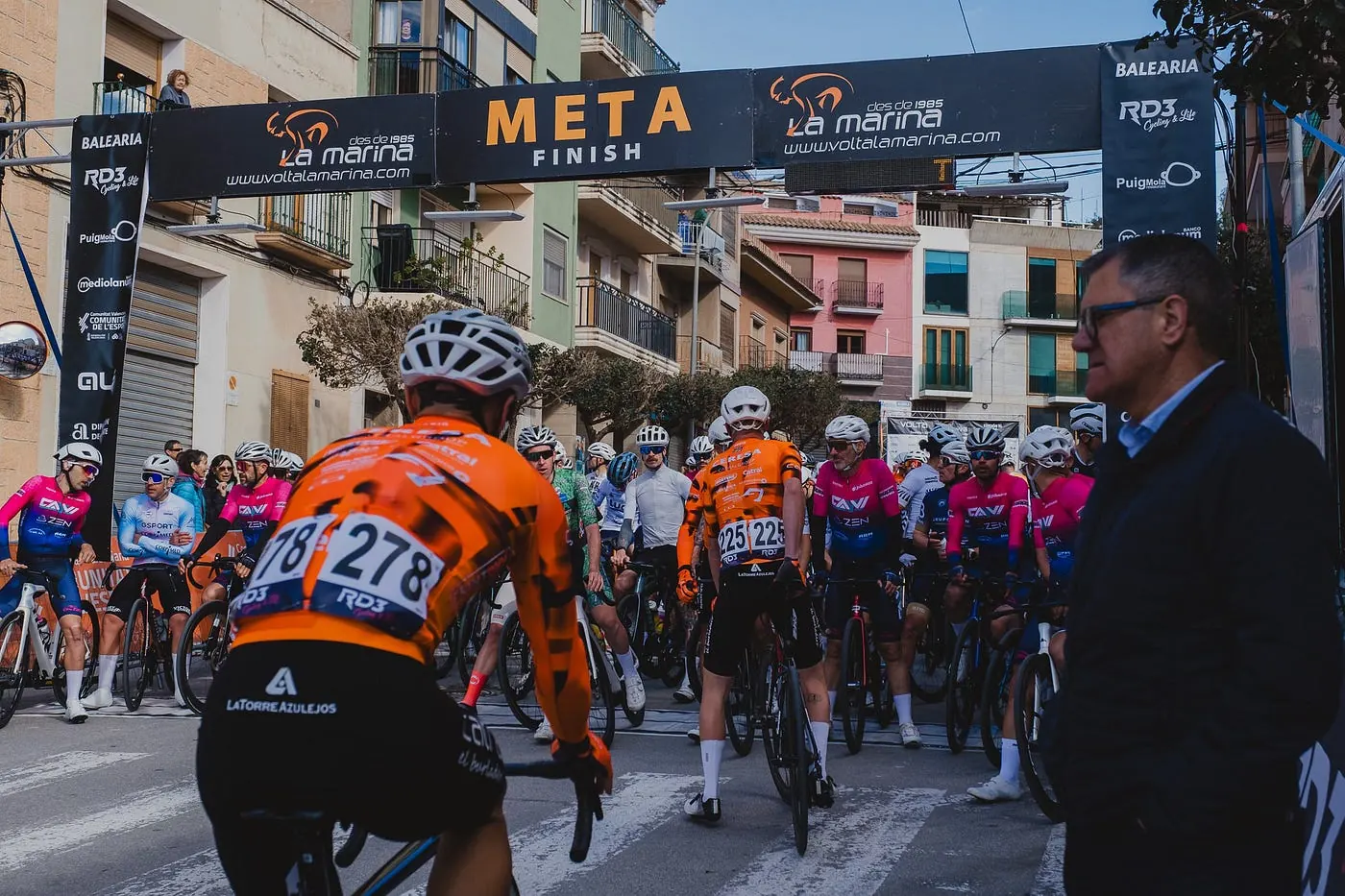
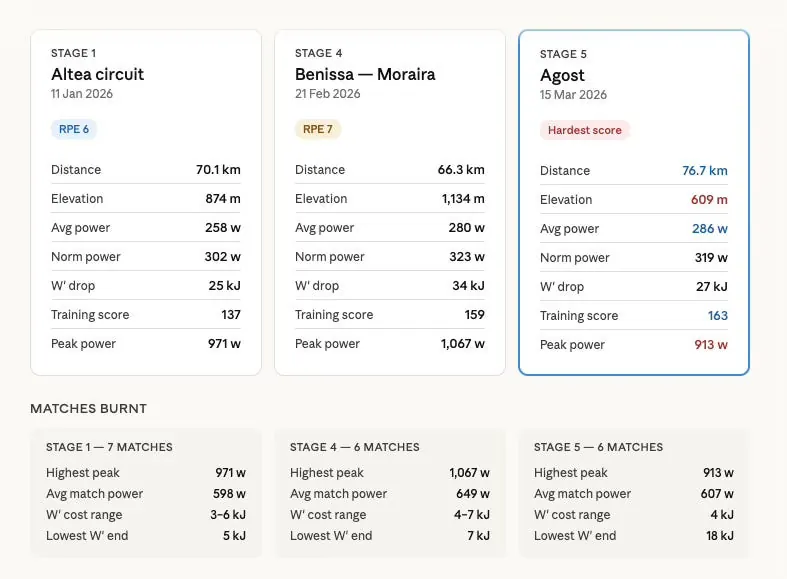
The Volta La Marina started in January on the Altea circuit. 70.1 km, 874 m of climbing, a training score of 137. It was my first race back after a long block of structured work and, honestly, that was the entire ambition — get round, stay upright, see where I sat.
I finished in the top 30 out of 200 riders. I’ll take that. But what the stage also told me was clear: I didn’t have the snap to respond to sharp accelerations. When attacks came, I could hold a tempo — 258 W average, 302 W normalised — but I couldn’t answer the repeated, sudden efforts that racing demands. I wasn’t being dropped by fitness. I was being dropped by a specific gap in my training.
We noted it. We built it in.
Stage 2: The lesson arrives early
Stage 2 was flatter, and in theory, more manageable. It wasn’t. A flatter stage at this level doesn’t mean easier — it means the pace is just relentlessly high, and the attacks come in short, violent bursts off the front rather than stretched out on gradients.
I survived. But survivability wasn’t what I was after. The stage reinforced what Stage 1 had hinted at: durability under repeated high-intensity efforts was my limiter. Not threshold, not VO2 — the capacity to keep producing when the tank is already partially drawn down. We began targeting this directly in training. More repeatability work. More efforts on tired legs.
Stage 3: Racing sick
A stomach infection the week before Stage 3 meant I arrived at the start line already compromised. This wasn’t a fitness stage for me — it was a survival stage. I raced it, got through it, and moved on. Some races are just about turning up and not quitting. That one was.
What matters is that Stages 1 and 2 had already given me a working hypothesis, and the training between blocks was building toward testing it. Stage 3 was noise. Stage 4 would be the next real signal.
Stage 4: The numbers climb
Benissa to Moraira. 66.3 km, but with 1,134 m of elevation — the most climbing of any stage in the series. Average power up to 280 W, normalised at 323 W, training score 159. Six matches burned, the highest peak power of the race at 1,067 W.
This was the stage where the training showed. The repeatability work we’d added after Stages 1 and 2 was visible in the numbers. W’ balance at the end: 7 kJ remaining. Tight, but managed. I came off the bike knowing I’d worked hard and done it well. The adaptation was real.
The training was working. The numbers said so. What the numbers couldn’t say was how much the weeks were costing beneath the surface.
Stage 5: The hardest score
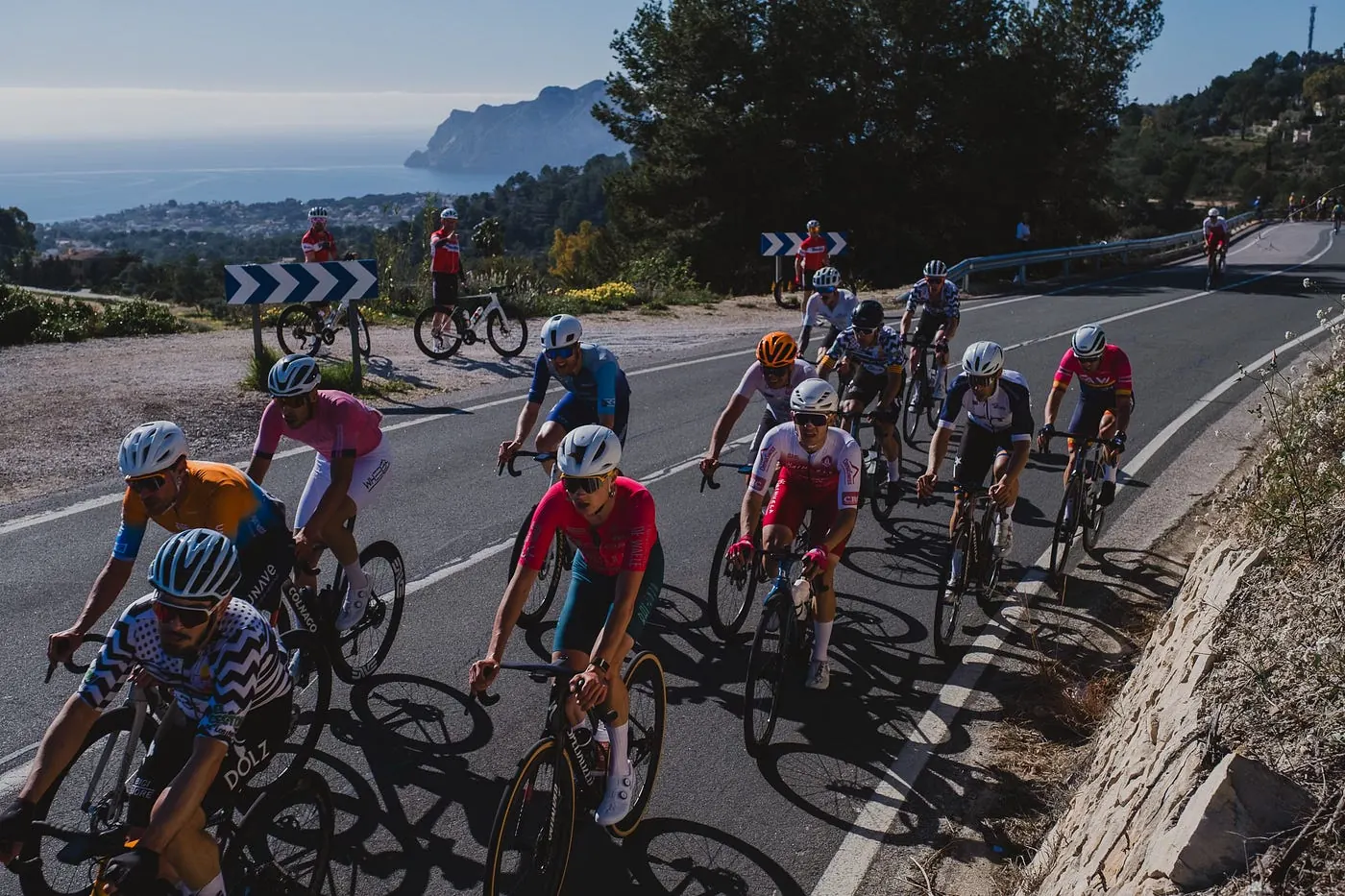
Agost. 76.7 km. Only 609 m of climbing — the flattest stage in the series. On paper: an easier day. The data said otherwise.
Training score: 163. The highest of the race. Average power: 286 W — my best across all five stages. Normalised power: 319 W. Peak power: 913 W — the lowest of the race. That gap between those last two numbers is where the whole story lives.
High output. Low peak. The engine was running — the explosiveness was gone.
The moment that crystallised it came on one of the final climbs. A gap opened. I was sitting mid-pack and suddenly there was space between me and the riders ahead. I dug in — 450 W — and couldn’t close it. Not because 450 W isn’t enough power in isolation. It is. But when you’re in hour three of a stage race in the fifth round of a series, the maths changes. That 450 W wasn’t buying what it would have bought fresh.
Myself and a group of about 14 others had to burn matches on the descent to get back onto the main pack. We managed it. But the cost was immediate. Once we were back on, the pace stayed — and it stopped being manageable for me. That was the end of any real racing. I rode out the stage. I finished. But I was cooked.
I was pushing 450 watts and going nowhere. The power was there. The ability to use it wasn’t.
The W’ balance at the finish confirms it: 18 kJ remaining. The most of any stage. That sounds like a good thing. It isn’t. It means I wasn’t able to spend it. By that point in the race, the system for delivering those efforts had already closed down. I had fuel left in the tank and no ability to burn it.
What the data actually says
The training block leading into this series has been genuinely good. My numbers across the week prove that — consistent power, good training scores, real progress on the repeatability work we built in after Stage 1. The fitness is there. The adaptation is happening.
But Stage 5 exposed a different layer: multi-day durability. The ability to carry that fitness across accumulated fatigue — not just one hard day, but five weeks of racing stacked on top of structured training — is its own quality. And it degrades in a specific, non-obvious way.
The warning signs were there in the match data too. Stage 5 had the same number of matches as Stage 4 — six — but the peak dropped by 154 W and the average match power fell from 649 W to 607 W. The matches were getting shorter and less effective, even as the underlying watts held up. That’s not a fitness problem. That’s a fatigue-distribution problem.
The positioning problem I can fix
There’s one thing the data can’t see but I can: I was in the wrong place when that gap opened. Racing mid-pack going into the final climbs in a fatigued state is a structural problem. The solution isn’t just training — it’s positioning. Moving to the front earlier in the stage, before the efforts that count, costs less energy than spending it clawing back after a gap has opened.
I knew this. Stage 2 taught it. I didn’t execute it. That’s the kind of mistake that only gets fixed by putting yourself in the same situation again and choosing differently — not by adding watts.
Anyways I hope you enjoyed this read. Please become a subscriber if this was your jam.